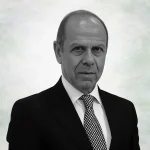
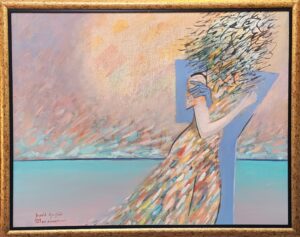
Karen Aghamyan (Yerevan, 1946) is one of the leading contemporary Armenian painters, a central figure in his country’s artistic scene and a point of reference for several generations of artists. He lives and works in Yerevan, where he has long combined his artistic practice with an intense academic activity as a professor at the State Academy of Fine Arts.
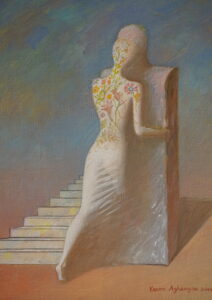
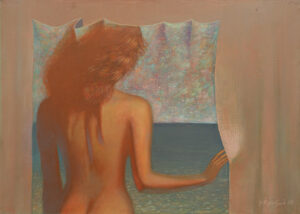
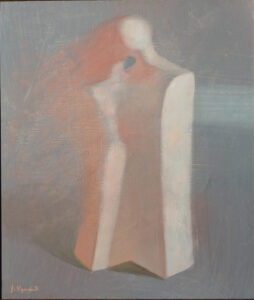
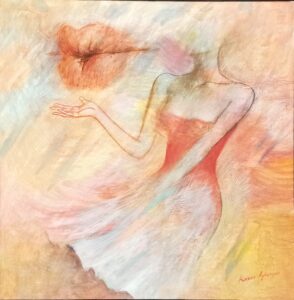
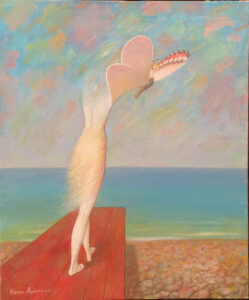
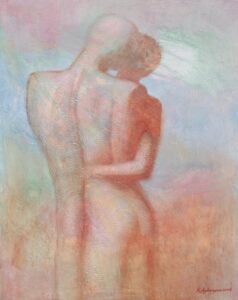
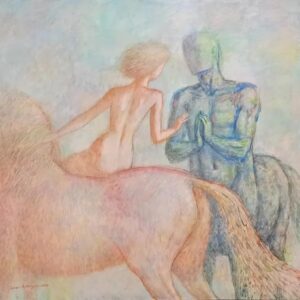
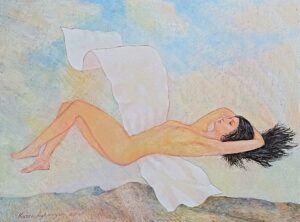
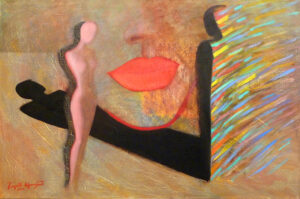
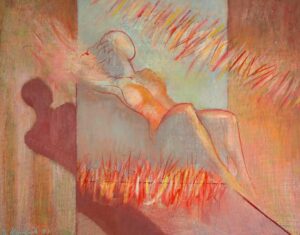
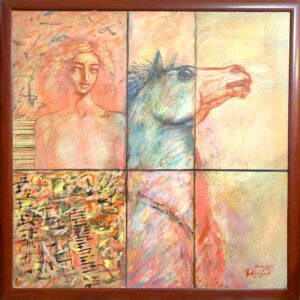
Educated at the P. Terlemezian Art College and later at the Yerevan Institute of Fine Arts and Theatre, Aghamyan developed, from the 1970s onwards, an independent pictorial language marked by a constant tension between abstraction and figuration, between symbolic construction and an emotional perception of space. His painting is distinguished by both analytical rigor and lyrical depth, where images emerge as suspended visions shaped by a strong inner dimension and a controlled yet powerful use of color.
Since 1970, he has participated in numerous exhibitions in Armenia and internationally, with solo and group shows in major cultural contexts including Paris, Marseille, Berlin, Prague, Seoul, and Hannover, where he was also featured within the framework of Expo 2000. His works are held in museum and private collections across several countries, including Armenia, Russia, France, the United States, and Japan.
Alongside his artistic production, Aghamyan has held prominent institutional roles within the Armenian cultural system: since 1998 he has served as President of the Artists’ Union of Armenia and has actively contributed to the development of national cultural policies, including as a member of the Presidential Council on Culture.
His research can be understood as an ongoing investigation into the relationship between form and thought, memory and contemporaneity. Often described as “hermetic” and deeply reflective, his works articulate a vision of art as a space for critical awareness, where reality is observed, filtered, and reconfigured through complex and highly personal expressive systems.